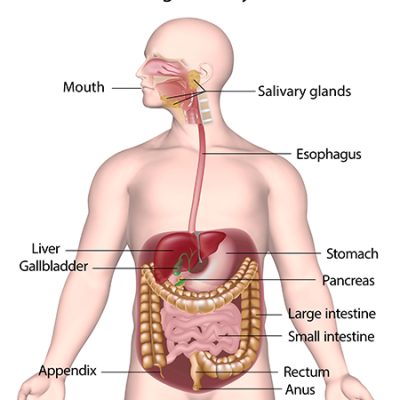
In the human body, digestion occurs both chemically/enzymatically and mechanically in the gastrointestinal tract. The components of the digestive system work together to turn food […]
Continue reading
Gastrointestinal System
The gastrointestinal (GI) system is made up of the gastrointestinal tract and accessory organs and structures. These organs are involved in digesting food, metabolizing and […]
Continue readingThe Intestines
The intestines are a central part of the gastrointestinal tract, where food is digested and nutrients and water are absorbed. They take up most of […]
Continue readingMesentery
The nature of the mesentery is still a matter of investigation. It is currently being considered as a single, large lymphatic organ, but it has […]
Continue reading
The Liver
The liver is the largest solid organ in the human body. It is also highly vascularized and, in an adult, contains approximately 1 pint of […]
Continue readingCervical Spine
The cervical spine consists of the first seven vertebrae of the spinal column (denoted as C1-C7), starting at the base of the skull. This part […]
Continue readingSense of Taste
The tongue is responsible for our sense of taste. See this post for tongue anatomy. The surface of the tongue is covered in more than […]
Continue reading
Tongue Anatomy
Function and structure From its place in the oral cavity, the human tongue takes part in talking, eating, and swallowing. It is muscular and moves […]
Continue readingThe Cranium or Skull
Updated March 11, 2022 The cranium is defined in English as the skull without the mandible, but it is generally accepted in medical terminology to […]
Continue reading
Facial Bones
Updated November 5, 2024 Fourteen (14) facial bones are part of the human skull. The distinct features of the human face are caused by the […]
Continue reading