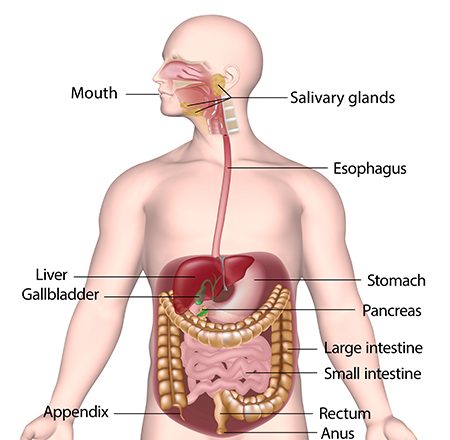
In the human body, digestion occurs both chemically/enzymatically and mechanically in the gastrointestinal tract. The components of the digestive system work together to turn food that is ingested into energy and nutrients that can be used by the body. Any unusable or excess byproducts are then eliminated as waste.
Path of Digestion
Digestion starts when food enters the oral cavity – the mouth – where it is mechanically broken down by the teeth as the tongue moves it around in the process known as chewing. Chemical digestion also begins in the mouth by salivary enzymes secreted by glands in the oral cavity.
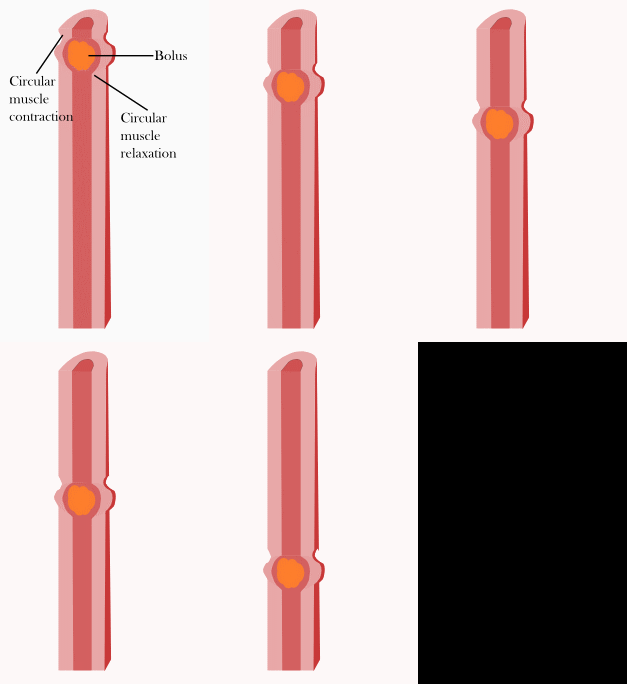
The masticated (chewed) food is pushed to the back of the oral cavity, where it triggers the swallow reflex in the throat. It then enters the esophagus, which squeezes the food into a ball called a bolus. The presence of this bolus in the esophagus stretches the muscle, stimulating another reflex – peristalsis.
At the end of the esophagus, the lower esophageal sphincter relaxes to allow the bolus to exit into the stomach.
In the stomach, gastric juices further break down the food into chyme, which is pushed into the intestines, where the bacteria of the gut microbiome act on it. Peristalsis occurs throughout the intestines and is reliant on the myenteric plexus. The digested food continues through the small intestine and into the large intestine, or colon, with nutrients and water being absorbed from undigestible components and waste byproducts.
At the end of the process, solid waste consolidates in the rectum until it exits the body via the anus.
Swallow and Gag Reflexes
Receptors in the lower pharynx, larynx, and epiglottis trigger an involuntary phase of muscle contraction/relaxation that moves chewed food into the esophagus. This process of swallowing involves sequential activation of the tongue and the pharyngeal and laryngeal muscles. The flap-like epiglottis moves to prevent access to the trachea, avoiding aspiration, and the upper esophageal sphincter relaxes.
See a video of an MRI of someone swallowing here.
Food that pushes into the tonsils and uvula at the top of the back of the oral cavity trigger the pharyngeal reflex – or gagging – as a protection against swallowing something that is too large to pass through the lower pharynx. It results in coughing to clear the obstruction.
Peristalsis
The stimulating stretch in the esophagus results in the secretion of serotonin, which affects sensory neurons.
Two cholinergic pathways then control the peristaltic movement of the food bolus that was swallowed. In the retrograde pathway, substance P and acetylcholine cause contraction of a ring of muscle above the bolus. In the anterograde pathway, nitric oxide and vasoactive intestinal polypeptide cause relaxation of a ring of muscle below the bolus. The difference in exerted force causes the bolus to move downward towards the stomach.

Biome
The human intestinal tract contains hundreds of different bacterial species that aid in digestion. This is just part of the thousands of organisms within the human digestive system known as the gut microbiome. Most digestion-related bacteria live in the colon, with some in the ileum and potentially other portions of the small intestines. These bacteria digest via fermentation carbohydrates, proteins, and fats that were not digested earlier in the GI tract. This is also one of the major processes that produce flatulence. A 2022 review has great imagery for this.
Bile Secretion
The liver produces bile, which is stored in the gallbladder, and the pancreas produces enzymes such as amylase, lipase, and protease. They flow through the bile duct and pancreatic duct via peristalsis to reach the small intestines, where they participate in the digestion process.
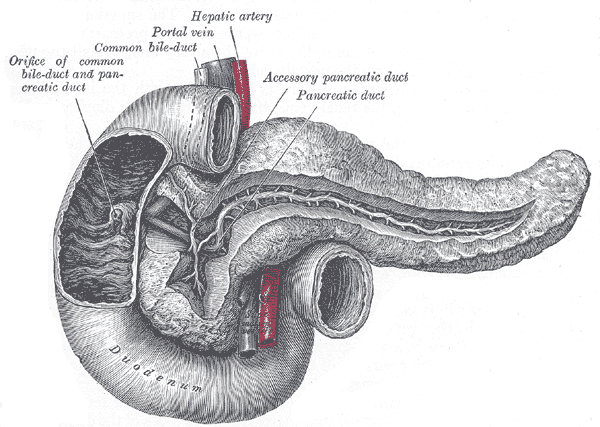
Three layers of smooth muscle form a sphincter that controls the flow of bile from the ampulla of Vater, where the common bile duct and pancreatic duct join and meet the small intestine. This sphincter is called the hepatopancreatic sphincter or sphincter of Oddi. The “normal” state of the sphincter is to block the entry point between the duct and intestinal lumen. After a meal, when bile is needed, the tone of the sphincter of Oddi decreases (“relaxes”) to allow the digestive juices to enter the small intestine.
The hormones involved in opening the sphincter include cholecystikinin, motilin, and secretin, whereas closing of the sphincter is influenced by somatostatin.
Nutrient and Water Absorption
When chyme exits the stomach into the small intestine, peristalsis keeps it moving and pushes the mixture against the walls of the intestine to help with the absorption of nutrients into the bloodstream. In the large intestine, this same process aids in the absorption of water from the remaining digested material.
The remaining undigested material and waste is pushed into the rectum by peristalsis of the colon. The ability of the intestines to achieve this is called colonic motility.
The intestines are also where metabolites are absorbed into the bloodstream and vitamins are produced.
Waste Byproducts
When sugars and starches are broken down, they produce gases. Some of these gases produced during digestion are absorbed into the blood, some of it is “eaten” by the bacteria of the biome, but much of it finds its way out with the feces, known as flatus. Sometimes air is taken in during eating or accumulates higher up in the digestive system, resulting in a release of gas via the mouth. Eructated gas (via the mouth) can also be a byproduct of ingested carbonation.
In contrast, intestinal gas is made up of a number of different gases from various sources:
- Carbon dioxide: from swallowed air, released by the stomach when bicarbonate in digestive juices mix with stomach acid, and from the breakdown of carbohydrates.
- Oxygen: from swallowed air.
- Nitrogen: from swallowed air.
- Hydrogen: from the breakdown of carbohydrates (flammable).
- Methane: only produced in about a third of people from the breakdown of carbohydrates (flammable).
- Sulfides: particularly hydrogen sulfide (asphyxiant), produced by bacteria in the large intestine and is dependent on the food ingested.
In addition to bacterial byproducts dependent on the constituents of the biome.
Feces is the solid waste of the digestive process, mostly mad of indigestible or unabsorbable material. Food enters the mouth, feces exits the anus via defectation.
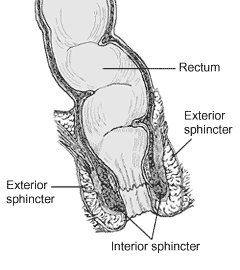

The storage area for feces between the colon and anus is the rectum. As the rectum fills and stretches, a reflex is triggered to push the waste towards the exit. Parasympathetic signals cause the internal and external sphincters to relax, allowing the rectum to empty. There is some voluntary control over the external sphincters, but suppressing the reflex can lead to constipation.
Toxin Excretion
“Fecal excretion” is a process of toxins or waste from metabolism passing directly into the intestines for excretion in the feces rather than being something that followed the path of digestion. The other form of toxin excretion into the feces is biliary excretion, where it goes from the liver to the biliary tract and then into the intestines.
Disclaimer: This page is for informational and learning purposes only. It is not meant to diagnose or treat any medical condition and should not be used in place of speaking with a medical doctor or seeking treatment.
Aliconia Publishing, LLC and the author make any and all attempts to ensure the accuracy of the presented facts. If you find an issue with any information on these pages, please use the Contact page to alert us. The content is subject to change based on new information or to be updated with additional facts. The date of last change is stated under the main header.
Discover more from Just Facts
Subscribe to get the latest posts sent to your email.