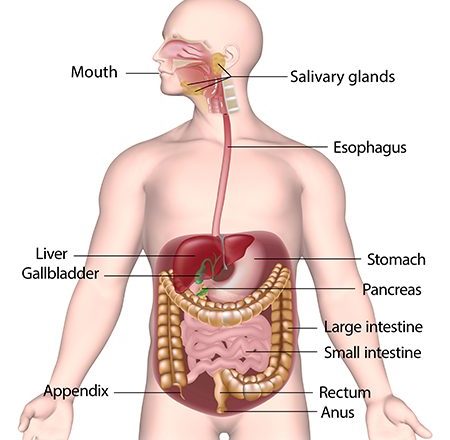
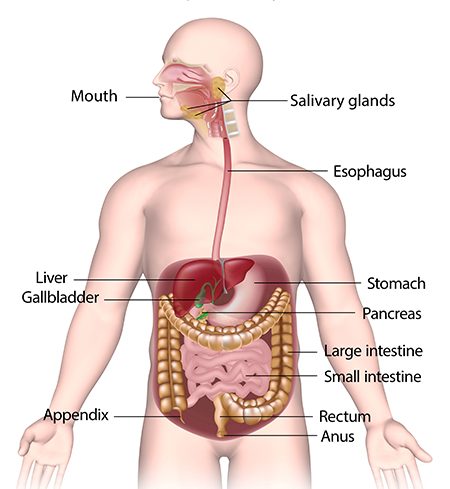
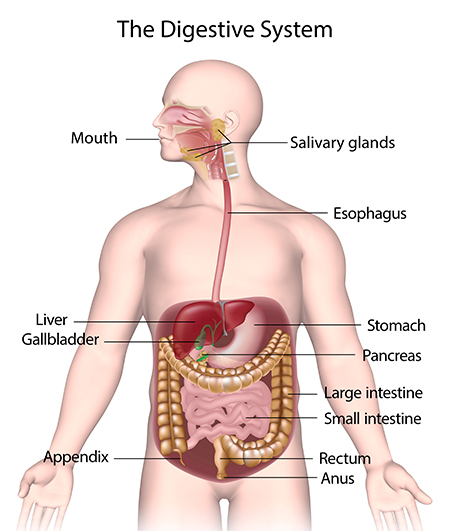
The gastrointestinal (GI) system is made up of the gastrointestinal tract and accessory organs and structures. These organs are involved in digesting food, metabolizing and absorbing water and nutrients, and excreting the waste byproducts.
The system is usually thought of as the digestive tract, a muscular tube network that starts with the esophagus and ends with the rectum. Between these two ends of the system is the stomach, small intestine, and large intestine. At each end of the tract is a sphincter – the upper esophageal sphincter at the top and the anus at the bottom.
But the GI system also includes accessory organs that secrete digestive enzymes, including the saliva glands, pancreas, gall bladder, and liver, as well as structures that act mechanically to assist in digestion, including the mouth, specifically the teeth and tongue.
Esophagus
The esophagus is a muscular tube that carries food via peristalsis from the pharynx to the stomach. At either end of the esophagus are sphincters.
The upper esophageal sphincter is a muscular ring where the trachea and esophagus divide off from the pharynx. It relaxes during the swallowing reflex and contracts during rest to prevent air from diverting into the stomach.
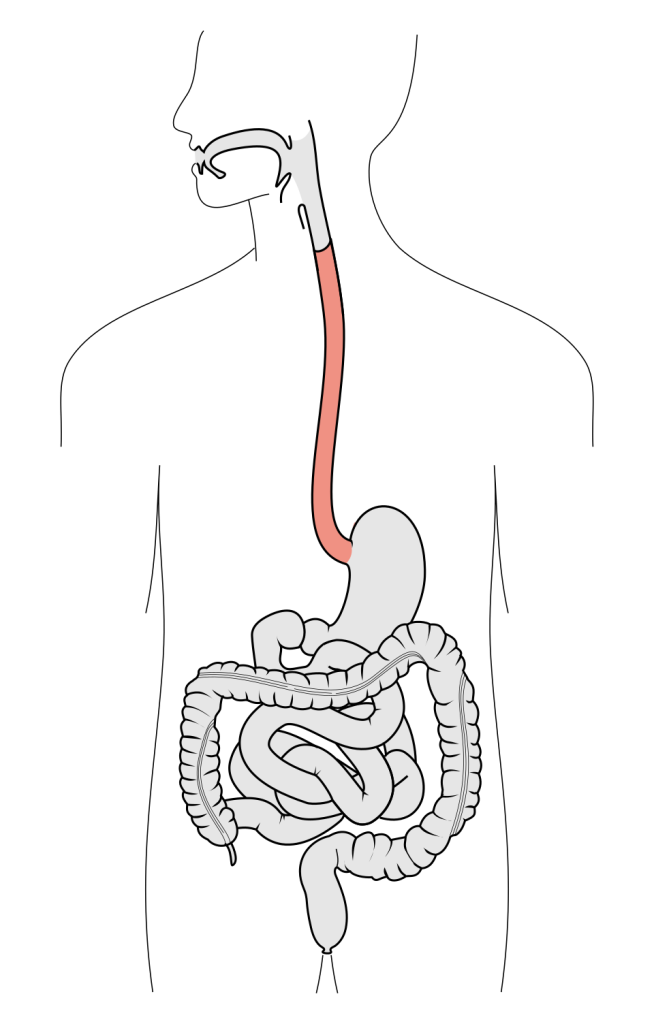

The lower esophageal sphincter connects the esophagus to the stomach. It also relaxes during the swallowing reflex and contracts at rest. It prevents the backflow of stomach acid and digested food into the esophagus. For more information see GrossHumanBody.
Stomach
The stomach has a pouch-like shape and connects the esophagus with the small intestine. It is sometimes referred to as being hollow, though it is actually never empty. The stomach both mechanically and chemically digests food into a mixture called chyme, which it stores until the small intestine is ready for it.
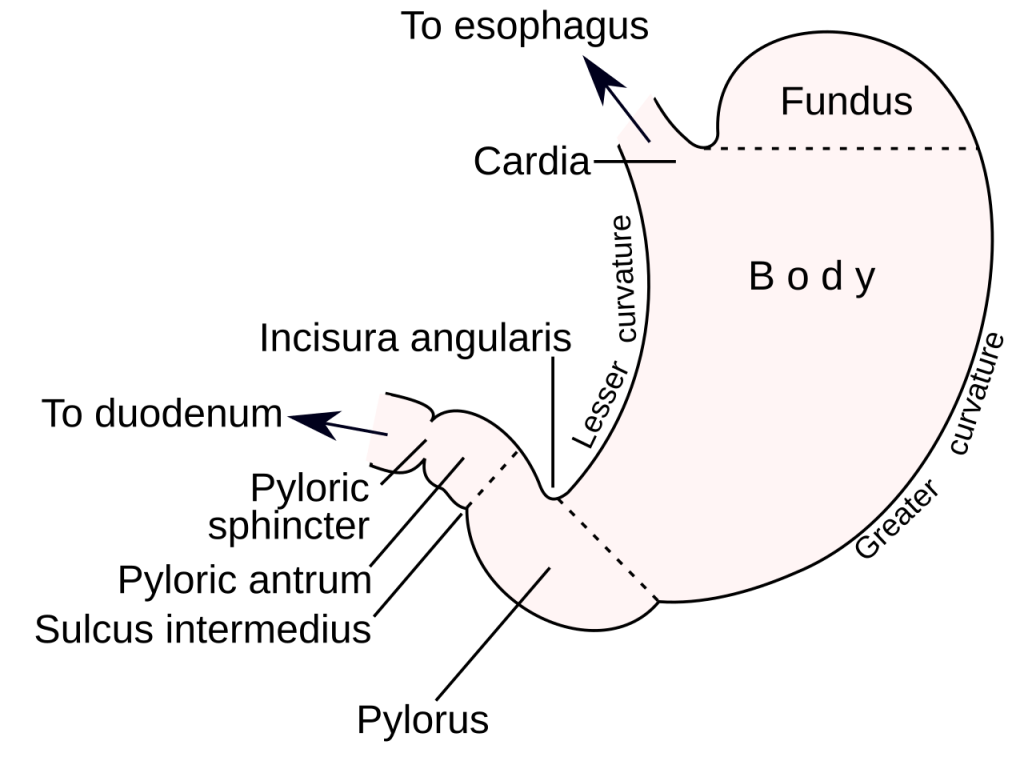

The stomach is made up of a muscular wall lined on the inside by mucous membrane (mucosal layers) containing glands that secrete digestion enzymes and acid, known in combination as the gastric juices. The cells within this layer include:
- surface mucosal or foveolar cells produce mucus that protects the gastric lining and regenerate as needed to keep the protective layer intact;
- parietal cells secrete hydrochloric acid in the fundus, as well as intrinsic factor for B12 absorption;
- chief cells are present in the gastric glands (or gastric pits) in the fundus and produce pepsinogen, which is broken down to pepsin by hydrochloric acid;
- neuroendocrine cells produce various hormones involved in digestion and muscle function. These cells include enterochromaffin-like (ECL) cells.
The various hormones produced in the stomach include:
- ghrelin (P/D1-cells) – increases hunger and fat storage
- serotonin (EC-cells) – regulates gastrointestinal motility and fluid secretion
- somatostatin (D-cells) – suppresses gastrin to reduce acidity in the stomach
- histamine (ECL cells) – induces hydrochloric acid secretion
- gastrin (G-cells) – stimulates ECL cells
The muscle layer of the stomach, the muscularis externa, is made of three layers of smooth muscle cells in various orientations that contract and relax to mechanically act on the food-enzyme mixture for digestion.
The interior wall is ridged with folds called rugae, which increase the surface area of the interior of the stomach. The stomach wall also contains mucosa-associated lymphoid/lymphatic tissue (MALT), which plays a role in surveilling ingested food for pathogens and toxins.
The outermost serosal layer is a membrane that is continuous with the peritoneum. It is made of squamous epithelial cells.
Intestines
Rectum
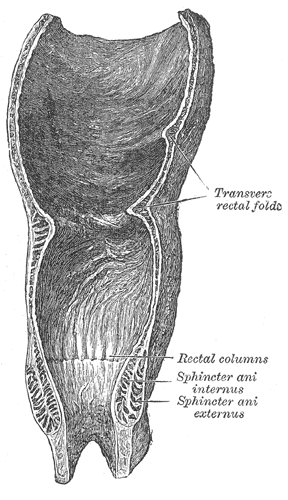
The rectum is continuous from the end of the sigmoid colon, meeting at the rectosigmoid junction. Solid waste is stored in the rectal ampulla prior to excretion through the external orifice – the anus. This release is under the control of a set of muscles – the anal sphincters.
The internal anal sphincter is smooth muscle under involuntary control and, along with stretch receptors in the rectal wall, triggers the urge to defecate – it relaxes when the rectum is full. This is called the anal sphincter reflex.
The external anal sphincter is skeletal muscle under voluntary control.
Accessory Organs
The liver produces bile, which is stored in the gallbladder, and the pancreas produces enzymes that are involved in digestion. They flow through ducts (bile duct and pancreatic duct) to reach the small intestines, where they participate in the digestion process.
For information on the Sphincter of Oddi, which controls bile secretion into the GI system, see GrossHumanBody.
Disclaimer: This page is for informational and learning purposes only. It is not meant to diagnose or treat any medical condition and should not be used in place of speaking with a medical doctor or seeking treatment.
Aliconia Publishing, LLC and the author make any and all attempts to ensure the accuracy of the presented facts. If you find an issue with any information on these pages, please use the Contact page to alert us. The content is subject to change based on new information or to be updated with additional facts. The date of last change is stated under the main header.
Discover more from Just Facts
Subscribe to get the latest posts sent to your email.